EPR | The Checklist for Product Compliance

Compliance with the EPR regulations has become essential for any manufacturer or seller of electrical and electronic products in France. This practical guide helps you quickly assess your obligations and ensure your business is compliant through a clear and actionable checklist.
Here you’ll find the essential rules, key steps, and tips for avoiding fines, product removals, or delisting from marketplaces.
EPR WEEE: Are Your Electronic Products Compliant? The Checklist.
Reading time: ~12 min
Understanding the EPR for Your Electronic Products
The EPR (Extended Producer Responsibility for Waste Electrical and Electronic Equipment) stems from the European WEEE Directive. It makes you responsible not only for placing your products on the market, but also for their end-of-life management.
Any company that manufactures EEE under its own brand, imports EEE manufactured abroad into France, or sells EEE to French customers remotely from abroad is considered a producer. This applies to all electrical and electronic equipment, whether household or commercial, with no minimum threshold: a single sale in France is sufficient.
In the event of non-compliance, penalties can range up to tens of thousands of euros, and products may be removed or delisted from marketplaces that require proof of EPR registration.
EPR Checklist to Verify the Compliance of Your EEE
This checklist covers the requirements applicable to most products placed on the market after August 13, 2005.
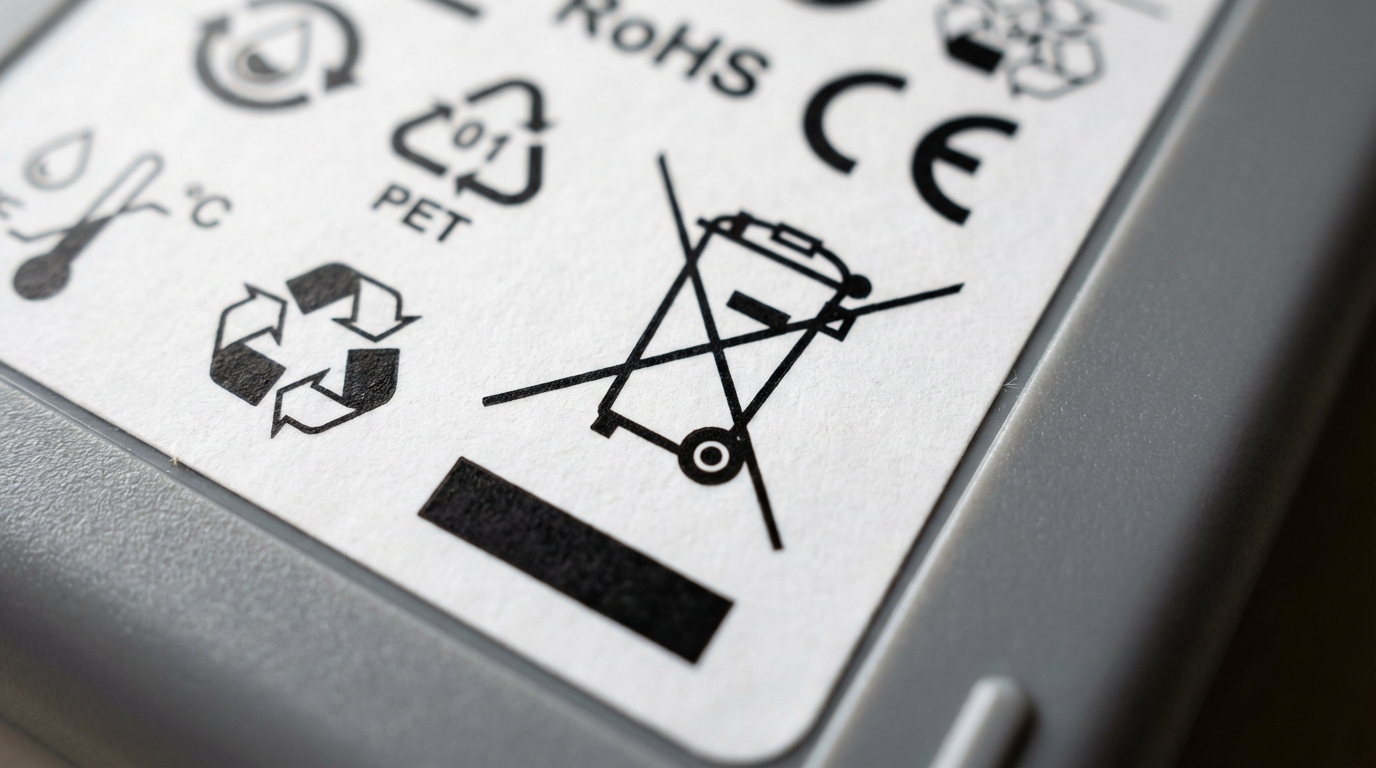
1. Determine whether your products fall under the scope of the EPR
Compile a complete list of EEE sold in France and classify them by regulatory category.
• Large and small appliances: refrigerators, vacuum cleaners, microwaves…
• IT and telecommunications: computers, routers, smartphones…
• Consumer electronics: televisions, game consoles, audio equipment…
• Lighting equipment: light fixtures, LED lamps…
• Power tools or electronic tools: drills, sanders…
• Toys, recreational items, or sports equipment that incorporate electronics
• Medical devices, monitoring and control instruments
Compile this data into a single file; you can use it for all your filings.
2 Apply the marking and provide end-of-life information
Each affected EEE must bear the “crossed-out wheelie bin” symbol in a legible and indelible manner, ideally on the product itself or, if that is not possible, on the packaging or in the instructions. Include clear instructions: do not dispose of with household waste; details on return procedures or drop-off locations; and useful information on recycling, particularly if the product contains hazardous substances.
3 Register and join an eco-organization or an individual system
There are two options: join an accredited waste management organization (the most common solution) or set up an individual system subject to approval. In either case, keep an up-to-date contract, official credentials, and reliable records of your waste reports.
4 Funding the Collection and Recycling of WEEE
The “polluter pays” principle applies: you pay an eco-fee calculated based on set rates (quantity, weight, type). For household appliances, this eco-fee must be listed separately from the price. Automated tracking of the rates minimizes errors and reduces manual work.

5. Check the additional regulations that apply to your products
In addition to the EPR , be sure to comply with: the RoHS Directive (restriction of hazardous substances), CE marking (safety, electromagnetic compatibility, low voltage), the repairability index for certain product categories, and, starting in 2024, the requirement for USB-C chargers for various portable devices.
6 Document and report your commitments
Keep your declarations of conformity, membership agreements, proof of payment for eco-contributions, and annual reports. An internal dashboard summarizing scope of application, labeling, registration, financing, additional regulations, and reporting simplifies audits and requests from marketplaces.
Steps to ensure your products comply with EPR regulations
Step 1: Self-assessment of the catalog
List all your items, assign them an WEEE category, and identify any missing labeling or end-of-life information. For more details, see our in-depth article on the steps to achieving EPR compliance.
Step 2: Contact one or more appropriate environmental organizations
Depending on the type of products (household or commercial) and the quantities involved, contact the relevant recycling organization to find out about the procedures for enrollment, reporting, and calculating recycling fees.
Step 3: Ensure product technical compliance
If necessary, have tests conducted by accredited laboratories (electrical safety, EMC, RoHS) and keep all reports on file.
Step 4: Establish ongoing monitoring
Regulations change regularly. Set up a monitoring system or delegate this task to a partner to stay up to date on restricted substances, new guidelines, or upcoming requirements.
How CompliancR Your EPR Compliance
In addition to WEEE obligations, there are also requirements regarding packaging, batteries, furniture, textiles, and more. As an authorized representative, CompliancR all of these sectors on your behalf. Our platform automatically analyzes your catalog (or barcodes) to identify products covered by each Scheme, apply the latest fee schedules, prepare declarations by the appropriate deadlines, and provide the identifiers required by authorities and marketplaces. For more information, visit the dedicated page: EPR Agent EPR E-commerce.
Mini FAQ EPR for Online Sellers
I’m a seller on a marketplace—does this apply to me? Yes. This article, specifically for marketplace sellers, outlines your key obligations: any sale of EEE to French customers—even if you don’t have a French entity—makes you a producer under the WEEE Directive; registration and reporting are therefore mandatory.
Is there a volume threshold for exemption? No. There are no volume-based exemptions; at best, some recycling organizations offer simplified programs for very small volumes.
Can I handle WEEE compliance on my own? Yes, but you’ll need to stay up to date on regulatory changes, apply the applicable rates, and file each report. This option is feasible for a small product catalog.
What are the risks of non-compliance? Administrative fines, compliance requirements, product recalls, and delisting from marketplaces.

In summary
EPR compliance is based on six pillars: identifying the products in question, applying the appropriate marking, joining an eco-organization, funding recycling, complying with additional technical regulations, and documenting all your actions. Following this checklist protects your business and contributes to responsible e-waste management. To outsource all of these tasks, including other EPR streams, explore our solutions: automated EPR management.